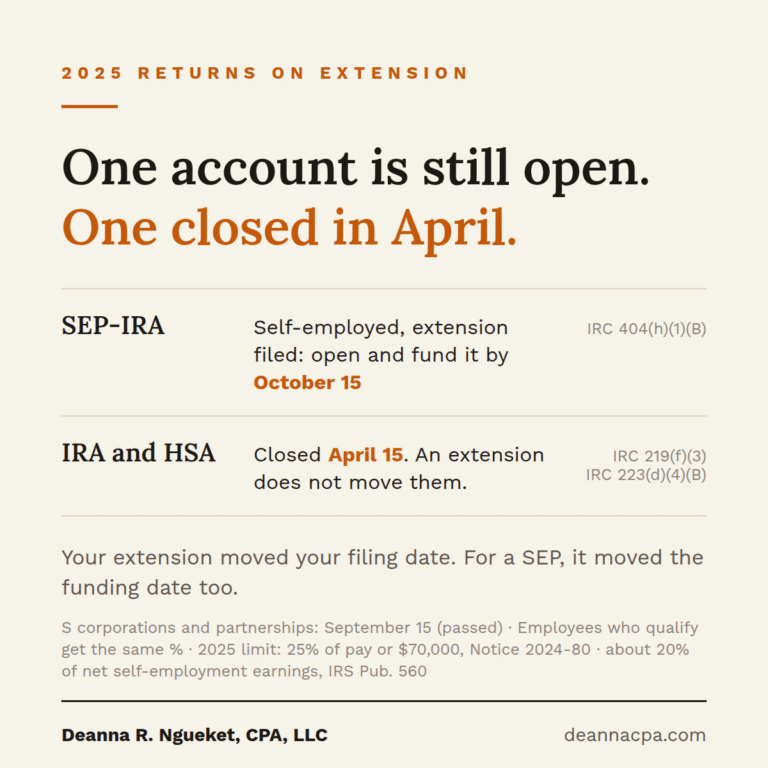
Update, November 2026: The 2025 SEP-IRA window closed on October 15, 2026. The same rule carries into 2026: you can open and fund a SEP for 2026 up to your return’s due date, including extensions (IRC § 404(h)(1)(B)). For most sole proprietors, that’s April 15, 2027, or October 15, 2027 if you extend. Your regular IRA and HSA contributions for 2026 still stop at April 15, 2027, with no extension (IRC § 219(f)(3)).
If you put your 2025 return on extension, you probably think of October 15 as the day the paperwork is due. It is. But for many self-employed people, it is also the last day to do something that lowers the tax on that return.
If you work for yourself and filed an extension, you may still be able to open a SEP-IRA, put money in it for 2025, and deduct it on the 2025 return you are about to file. The last day is October 15, 2026.
Your regular IRA, Roth IRA and HSA don’t work that way. Their 2025 deadline was April 15, 2026. The extension did not change it.
Here’s why the two rules are different, and how to tell whether October 15 is really your date.
Check these three things first
- Did you file an extension by April 15? If not, your SEP deadline was April 15, 2026. Filing late does not give you more time to fund the plan. It only adds late-filing penalties.
- Is your business on Schedule C of your personal return? That includes a single-member LLC that hasn’t elected to be taxed as a corporation. If you own an S corporation or a partnership, your business return was due September 15, 2026. That date has passed.
- Do you have employees? If any of them qualify, you must put the same percentage of pay into the SEP for them as you put in for yourself. More on that below.
If you’re not sure about any of these, call me before you send money anywhere. It’s a short conversation.
Why a SEP gets extra time
The tax law gives the two accounts different deadlines, and the wording shows it.
For a SEP, the law counts a contribution for 2025 if it goes in by the due date of the 2025 return “(including extensions thereof).”
Source: IRC 404(h)(1)(B)
For a regular or Roth IRA, the law uses almost the same sentence, but it says “(not including extensions thereof).”
Source: IRC 219(f)(3)
That one word, “not,” is the whole difference.
An HSA follows the IRA rule. The law points the HSA back to the IRA deadline, so the extension does not help there either.
Source: IRC 223(d)(4)(B)
You can open the plan this late, too
You don’t need to have had a SEP during 2025. The IRS says you can set one up “as late as the due date (including extensions) of your business income tax return for the year you want to establish the plan.”
Source: IRS, Simplified Employee Pension plan (SEP) page
So if you have no retirement plan at all, you can open one this week and still take a 2025 deduction. Not many tax decisions stay open after the year is over. This is one of them.
How much can go in
For 2025, the most that can go into a SEP is the smaller of:
- 25% of your pay, or
- $70,000.
Source: IRS Notice 2024-80
If you’re self-employed, “pay” doesn’t mean your full profit. The IRS first takes out half of your self-employment tax and the SEP contribution itself. Because of that, the 25% works out to 20% of your net earnings from self-employment. Measured against your Schedule C profit, that’s a little under 19%.
Source: IRS Publication 560, rate table for the self-employed
An example (an illustration only; your numbers will differ):
- Schedule C profit: $100,000
- Half of the self-employment tax: about $7,065
- What’s left: about $92,935
- 20% of that: about $18,590
If your top federal tax rate were 24%, an $18,590 contribution would lower your 2025 federal tax by about $4,460. And the money is still yours. It’s in your retirement account.
Your real number depends on your actual self-employment tax. Use the worksheet in Publication 560, or let me run it for you.
If you have employees, read this before you fund anything
A SEP is not just your account. An employee qualifies if they:
- are at least 21,
- worked for you in at least 3 of the last 5 years, and
- were paid at least $750 in 2025.
Sources: IRC 408(k)(2); IRS Notice 2024-80
If you put 20% in for yourself, you must put the same percentage of pay in for each qualifying employee, out of the same October cash.
Source: IRC 408(k)(3)(C)
If you work alone, this doesn’t affect you. If you have three long-time employees, it can change the math completely. That’s why a SEP isn’t always the right answer, even with the extra time.
What about a solo 401(k)?
The employer part of a solo 401(k) also gets the extension.
Source: IRC 404(a)(6)
The employee part (your “deferral”) does not. A sole owner can now start a new solo 401(k) after the year ends and still make first-year deferrals, but only until the return due date without extensions: April 15.
Source: IRS Publication 560, “Plans established after the end of tax year”
So if you’re starting from nothing in October, a new solo 401(k) could only take the employer part. That’s about the same as a SEP, and a SEP is simpler to open.
If you already had a solo 401(k) set up during 2025, check whether you can still add the employer part now. A solo 401(k) often allows more than a SEP at the same income.
What to do this week
- Confirm you filed an extension and that your business is on Schedule C.
- Get a good estimate of your 2025 profit. You can’t size the contribution without it.
- Count any qualifying employees, and figure out what they would cost before you commit.
- Open the account. It’s often same-day or next-day, but identity checks can slow it down. Don’t wait for October 14.
- Fund it, and keep the confirmation with your 2025 tax file. The deduction goes on Schedule 1 of Form 1040, not on Schedule C.
Money that arrives on October 16 doesn’t count for 2025. The date is firm.
If you’d like me to run your number before you put money in, call me at 713-730-9792 or email info@deannacpa.com. I’d rather spend fifteen minutes with you than see a good deduction land in the wrong year.
Sources
- IRC 404(h)(1)(B) and 404(a)(6): when employer plan contributions are treated as made. law.cornell.edu/uscode/text/26/404
- IRC 219(f)(3): IRA contributions, “not including extensions thereof.” law.cornell.edu/uscode/text/26/219
- IRC 223(d)(4)(B): HSA contributions follow the IRA timing rule. law.cornell.edu/uscode/text/26/223
- IRC 408(k)(2) and (k)(3)(C): SEP employee eligibility and the same-percentage rule. law.cornell.edu/uscode/text/26/408
- IRS Notice 2024-80: 2025 limits ($70,000; $350,000 compensation cap; $750 eligibility). irs.gov/pub/irs-drop/n-24-80.pdf
- IRS Publication 560 (2025), Retirement Plans for Small Business: rate table, worksheet, plan setup deadlines. irs.gov/publications/p560
- IRS, Simplified Employee Pension plan (SEP). irs.gov SEP plan page
- Treas. Reg. 1.6081-4: automatic six-month extension for individual returns. law.cornell.edu/cfr/text/26/1.6081-4
This article is general information, not advice for your situation. Deanna R. Ngueket, CPA, LLC.
Self-employed? See my guide to quarterly taxes for 1099 contractors.