Update, November 2026: The October 15, 2026 window for a superseding 2025 return has closed. If you need to change your 2025 return now, the route is Form 1040-X, an amended return. For your 2026 return, the same window runs to October 15, 2027 if you file an extension (Treas. Reg. § 1.6081-4).
Most people think a tax return is final once the IRS accepts it, and that the only way to change it is Form 1040-X. That’s true for most of the year. It isn’t true right now.
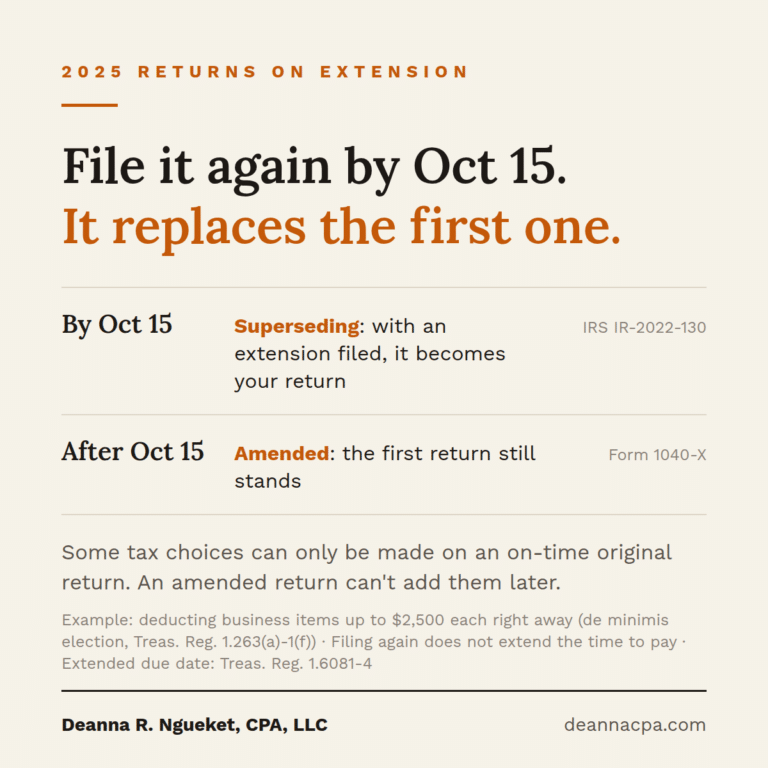
If your 2025 return is on extension, you have until October 15, 2026 to file a second return that replaces the first one instead of correcting it. The IRS calls this a superseding return: “a return that is filed after the originally filed return but submitted before the due date, including extensions.”
Source: IRS news release IR-2022-130
That sounds like paperwork. It isn’t. It can decide which deductions you’re still allowed to take.
Check these things first
- Did you file an extension by April 15? If not, your 2025 return was due April 15, 2026. Anything you file now is an amended return, not a superseding one.
- Will you owe more? Filing again doesn’t give you more time to pay. Interest on any 2025 balance has been running since April 15, 2026. If the new return shows more tax, you owe the difference plus interest.
- Is your return a Form 1040? October 15 is the extended due date for individual returns.
Source: Treas. Reg. 1.6081-4
Replacing is not the same as amending
An amended return is a change stacked on top of a return that already exists. Your first return stays on file, and the 1040-X adjusts it.
A superseding return is different. Because it arrives before the extended deadline, it becomes your 2025 return.
For most fixes, like a missing 1099, a wrong number or a forgotten deduction, either route gets you to the same place. The difference matters in one situation, and it’s the one worth knowing.
Some tax choices only exist on an on-time original return
Some tax elections can’t be made on an amended return at all. The rules say they’re made by attaching a statement to an on-time original return, including extensions. Miss that window, and the choice is gone for the year.
The one I see business owners miss most is the de minimis safe harbor election.
Source: Treas. Reg. 1.263(a)-1(f)
Here’s what it does. Without the election, an item you buy for the business that lasts more than a year usually has to be depreciated, so the deduction is spread over several years. With the election, you can deduct it right away, up to $2,500 per invoice or per item. (The limit is $5,000 if your business has audited or similar financial statements. Most small businesses don’t.)
The IRS explains how to make the election: you “attach a statement titled ‘Section 1.263(a)-1(f) de minimis safe harbor election’ to the timely filed original federal tax return including extensions,” with your name, address and taxpayer ID number.
Source: IRS, Tangible Property Final Regulations page
An example (an illustration only):
- A contractor bought eleven tools and two laptops in 2025.
- Each one cost between $900 and $1,800, so every item is under $2,500.
- Together they cost about $15,000.
With the election, that’s about $15,000 deducted on the 2025 return. Without it, the items go on a depreciation schedule and are deducted over five to seven years.
If the election statement was left off a return filed in April, a 1040-X can’t add it. A superseding return filed by October 15 can.
What it doesn’t change
It doesn’t extend anything. A superseding return doesn’t give you more time to pay, and it doesn’t move the October 15 deadline.
It isn’t for everyone. You must have filed an extension.
Not every change rides this date. For example, switching from a joint return to separate returns follows its own rule.
Source: Treas. Reg. 1.6013-1(a)(1)
If you’re thinking about that change, talk with me before you count on October 15.
How you file one
For years, a superseding individual return could only be filed on paper. That changed. The IRS added “a new, electronic checkbox … for Forms 1040/1040-SR, 1040-NR and 1040-SS/1040-PR to indicate that a superseding return is being filed electronically.”
Source: IRS news release IR-2022-130
So the steps are simple:
- Prepare the whole return the way it should have read, not just a list of changes.
- Check the superseding box.
- File it electronically before October 15.
The hard part is remembering to do it in time.
Who should take a second look before October 15
Pull your 2025 return back out if any of these is true:
- You filed early in the spring, in a hurry, to get it done.
- You bought equipment, tools, computers, furniture or small machinery in 2025, and you’re not sure how they were handled.
- Your return was filed before all your paperwork arrived, like a late 1099, a brokerage correction or a K-1.
- Your business changed during 2025, and the return was prepared on assumptions that turned out to be wrong.
- The result looked high, but you thought it was too late to do anything.
Look at your Schedule C and your depreciation schedule. If a stack of small purchases is being depreciated, ask whether the de minimis election was made.
The date, plainly
October 15, 2026 is the last day a second 2025 return can replace your first one. On October 16, the only route left is Form 1040-X, and some of what you could have fixed can’t be fixed anymore.
If you’d like me to look at a return you’ve already filed, call me at 713-730-9792 or email info@deannacpa.com. Bring the return and the depreciation schedule. It’s a short review.
Sources
- IRS news release IR-2022-130, “Taxpayers now have more options to correct, amend returns electronically”: definition of a superseding return and the electronic checkbox. irs.gov IR-2022-130
- Treas. Reg. 1.263(a)-1(f): de minimis safe harbor election. law.cornell.edu/cfr/text/26/1.263(a)-1
- IRS, Tangible Property Final Regulations: how to make the de minimis election; $2,500 and $5,000 limits. irs.gov tangible property regulations page
- Treas. Reg. 1.6013-1(a)(1): separate returns after a joint return. law.cornell.edu/cfr/text/26/1.6013-1
- Treas. Reg. 1.6081-4: automatic six-month extension for individual returns. law.cornell.edu/cfr/text/26/1.6081-4
This article is general information, not advice for your situation. Deanna R. Ngueket, CPA, LLC.