A free guide from Deanna R. Ngueket, CPA, LLC
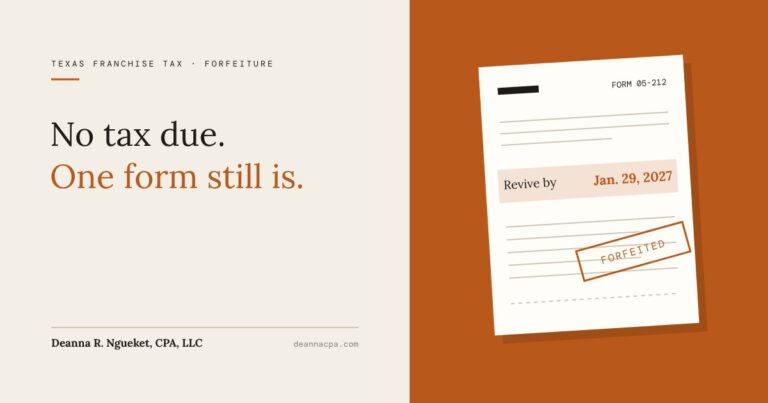
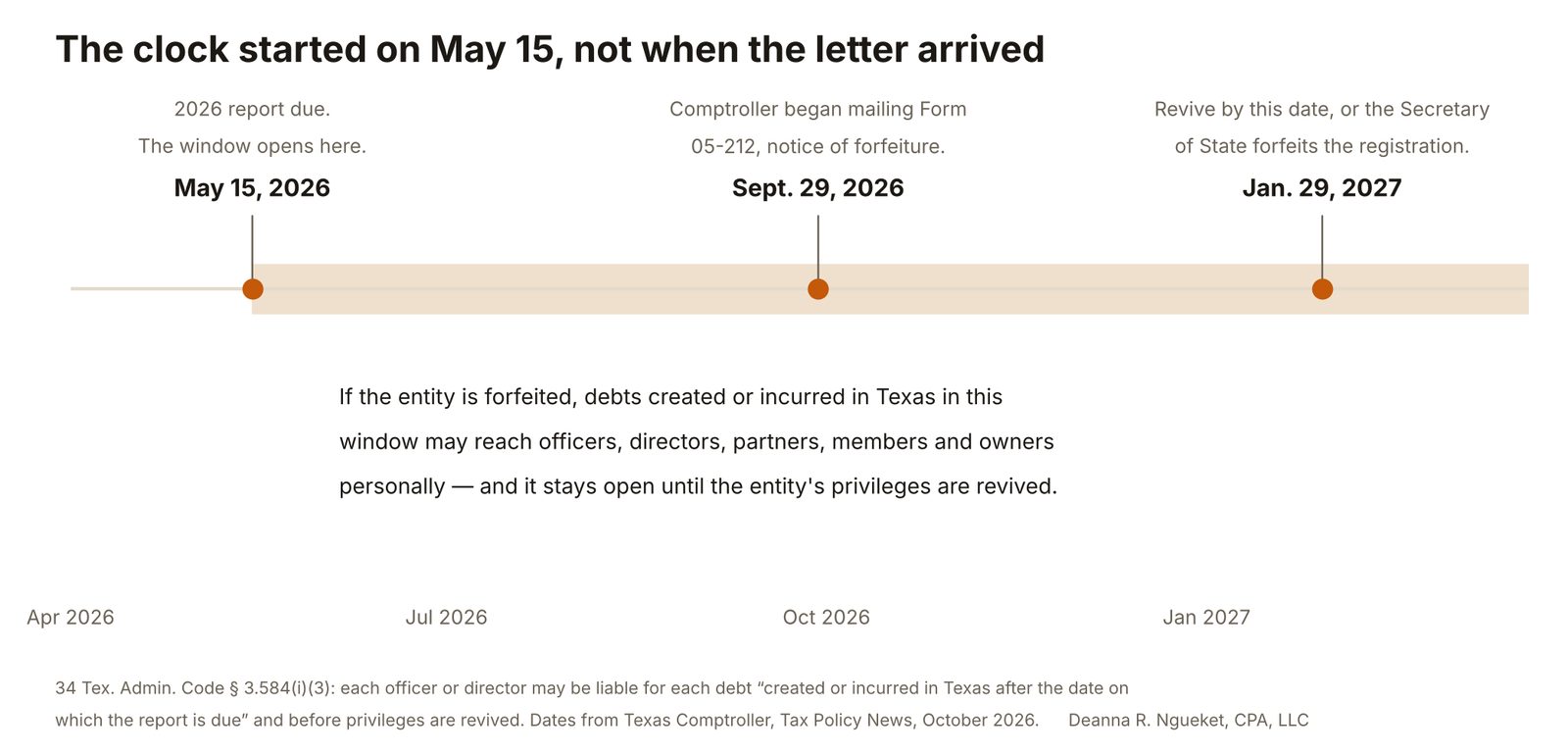
If you own a business in Houston, Spring, Humble or Atascocita and something from the Texas Comptroller showed up in your mail in October, this article is for you. On September 29 the Comptroller’s office “began mailing Form 05-212” — the Texas Notice of Forfeiture of Right to Transact Business — and it set a date: “If your entity’s right to transact business is not revived before Jan. 29, 2027,” the Secretary of State forfeits the entity’s registration.
That is roughly eleven weeks from today.
This article is also for the much larger group of owners who did not get a letter and are not sure whether they should have. Most of them are under the no-tax-due threshold, which for the 2026 report year is $2,650,000 of annualized total revenue, and they have reasonably concluded that Texas franchise tax is not their problem. On the tax, they are right. I have written separately about the no-tax-due threshold and what it does and does not excuse.
What I want to walk through here is the one filing that is left when the tax goes away, and what the Comptroller’s own rule says happens to you personally when it does not get filed. The three businesses below are composites — the kind of situation that comes through my door, not any one client.
The one form that is left
For the 2024 report year and later, the Comptroller discontinued the No Tax Due Report. An entity at or below the threshold “is not required to file a No Tax Due Report.” But the Comptroller is direct about what did not go away: that entity “is required to file Form 05-102, Public Information Report (PDF) or Form 05-167, Ownership Information Report (PDF).”
Which one you file is a question about how your business is organized, not about how much it earns:
- Form 05-102, the Public Information Report (PIR), is filed by each taxable entity “formed as a corporation, limited liability company (LLC), limited partnership,” plus professional associations and financial institutions.
- Form 05-167, the Ownership Information Report (OIR), is filed by each taxable entity “other than a legally formed corporation, LLC, limited partnership,” professional association or financial institution — mostly general partnerships, registered limited liability partnerships and trusts.
So nearly every small business I see in this area — the single-member LLC, the two-member LLC, the S corporation, the limited partnership holding a building, the professional association — files the PIR.
Both are due on the same day the franchise tax report is due. “The annual franchise tax report is due May 15,” and if May 15 lands on a weekend or holiday, the due date moves to the next business day. And in the line the Comptroller sets off as important: “The PIR or OIR is due even if the entity does not have to file a franchise tax report.”
That sentence is the whole reason this article exists. The filing most owners think they escaped by being small is the one they did not escape.
There is no $50 late penalty on this one, and that is the problem
If you file a franchise tax report late, Texas charges “an additional penalty of $50.00 for each late report,” and it applies “even if the taxpayer later files the report and/or if no taxes are due for the reporting period.”
The information report works differently, and the Comptroller said so plainly in October: “There is no $50 penalty for late filing a PIR or OIR.”
I want to be careful about how that reads, because it is easy to hear it as good news. It is not good news. It means Texas has not priced this filing at fifty dollars. It has attached a different consequence entirely, and the consequence is not a bill.
Under the Comptroller’s rule on information reports, 34 Tex. Admin. Code § 3.584(i)(3), failing to file a completed and signed report “shall result in the forfeiture of corporate or business privileges” under Texas Tax Code § 171.251, “Forfeiture of Corporate Privileges,” and § 171.2515, “Forfeiture of Right of Taxable Entity to Transact Business in this State.” Two sections, cited together, and the titles tell you the shape of it: one speaks in terms of corporate privileges, the other in terms of the right of a taxable entity — which is what your LLC is — to transact business in Texas.
You do get warning first. The Comptroller’s account-status page says it must “give at least 45 days, beginning after the notice of pending forfeiture is mailed,” and that “Any franchise tax deficiencies must be cured during that period.” That warning arrives as Form 05-211, “Texas Notice of Intent to Forfeit Right to Transact Business.” If the deficiency is not cured, the next letter is Form 05-212, “Texas Notice of Forfeiture of Right to Transact Business” — the one that started going out on September 29. And when the Secretary of State forfeits the registration, the Comptroller sends Form 05-213, “Texas Notice of Forfeiture of Registration.”
Once the right to transact business is forfeited, two things follow. The first is the one owners discover at the worst possible moment: “the entity will be denied the right to sue or defend itself in a Texas court.” Not only sue. Defend. The second is the one this article is really about: “each director or officer will be liable for the debt of the entity.”
One word of precision there, because it matters more than anything else on this page. The regulation is the binding text, and it says each officer or director “may be liable for each debt of the taxable entity.” The Comptroller’s October article narrows the debts rather than the people, saying officers, directors, partners, members or owners “will be liable for certain debts.” Neither source describes anything automatic, and neither describes anything unlimited. The exposure is real; it is bounded.
One carve-out worth naming while we are here: § 3.584(i)(4) excludes a banking taxable entity and a savings and loan association from all of this.
The clock starts on the report due date, not on the notice
Here is the sentence that changed how I think about this filing. Section 3.584(i)(3) says that each officer or director may be liable for each debt of the taxable entity that is “created or incurred in Texas after the date on which the report is due.”
Read that date again. Not the date the notice of intent was mailed. Not the date the forfeiture took effect. The date the report was due. The Comptroller’s October article says the same thing in plain words — the debts at issue are those incurred after the report or payment due date.
So for a 2026 report, the relevant period opens on May 15, 2026. It has been running quietly ever since, across every obligation the business took on in the meantime: the equipment lease signed in June, the supplier terms extended in July, the line of credit drawn in September. By the time the envelope arrived in October, the window had been open for more than four months, and the forfeiture reaches back into it.
The other half of that sentence matters just as much. The rule describes debts incurred “before the corporate or business privileges are revived.” Filing the missing form is not the thing that closes the window. Revival is — and revival is a multi-step process that ends at the Secretary of State, not a checkbox. I walk through the order further down.
Two honest limits, because I am not interested in frightening anyone into my office. This is a specific statutory liability for certain debts of the entity under Texas Tax Code § 171.255. It is not a general erasure of limited liability, and it does not reach backward past the report due date. And whether it reaches a particular person for a particular debt turns on facts that a web page cannot see. If a notice has already arrived at your business, that is a conversation to have with someone who can look at your actual record.
“Director” includes the manager of your LLC
A lot of owners read “directors and officers” and file it mentally under that is a corporation problem. The Comptroller’s rule closes that door. Under § 3.584(i)(5)(D), for these purposes “director includes a manager of a limited liability company,” and also “a general partner in a limited partnership” and “a general partner in a partnership registered as a limited liability partnership.” The Comptroller’s October article reaches wider still, naming officers, directors, partners, members and owners.
If you are the manager of your own Texas LLC, you are inside this rule.
And here is the piece that makes the whole thing click. The Public Information Report is the document that names those people. It “must be completed and signed by an officer, director or other authorized person,” the signer certifies the information, and the entity must certify that a copy of the report has been mailed to each person named in it who is an officer, director or manager and who is not employed by the entity, or by a related entity of at least 10% common ownership, on the date the report is filed. The Comptroller also says where the public record comes from: officer and director information on its website is “obtained from the most recent PIRs processed by the Texas Secretary of State (SOS).”
The form that identifies who carries this exposure is the same form whose absence creates it. That is not an accident of drafting. It is why the state cares whether a company with no tax to pay files anything at all.
Scenario one: the Humble consultant who thought she had nothing to file
A marketing consultant in Humble runs through a single-member LLC. Her 2026 annualized total revenue is $310,000 — comfortably under the $2,650,000 threshold, so she owes no franchise tax and files no franchise tax report. Someone tells her, correctly, that Texas has no personal income tax and that the No Tax Due Report is gone. She hears nothing to file and moves on. Her PIR for the 2026 report year never goes in.
On September 1, 2026 — 109 days after the May 15 due date — she signs a 36-month lease on office space and equipment at $1,850 a month. Total obligation, $66,600. That autumn the notice of intent arrives, the 45 days pass uncured, and her right to transact business is forfeited.
Notice the order. The lease came first. That does not put it out of reach, because the rule does not measure from the forfeiture — it measures from the date the report was due, and the forfeiture reaches back to it.
There is no $50 bill for the missing report. There is a $66,600 obligation of the LLC that, under § 3.584(i)(3) and Texas Tax Code § 171.255, her landlord could try to collect from her personally as the manager of that LLC, because it was created in Texas after the date the report was due and before her privileges were revived. Whether anyone ever tries depends on a landlord, a default and a lawyer. The point is that the question exists at all, and the filing that would have kept it from existing takes about fifteen minutes.
There is a quieter cost in her situation too. A forfeited entity cannot sue or defend in a Texas court, and when she goes to open a business account, sign with a franchisor or close on a loan, the lender asks for a Certificate of Account Status — the document that used to be called a certificate of good standing. Hers will not be the one she wants.
Scenario two: the Atascocita contractor who cannot sue for his own money
A construction company in Atascocita runs as an S corporation. Total revenue for the period is $3,180,000, nearly all of it from Texas customers. That is over the threshold, so this business has two filings, not one: a franchise tax report and the Public Information Report.
Texas does not tax revenue. It taxes margin, and margin is the lowest of four computations. With cost of goods sold of $1,740,000 and total compensation of $538,920 — the owner’s W-2 salary of $78,920, employee wages of $402,000 and benefits of $58,000 — the four run like this:
| How margin is computed | Margin | Tax at 0.75% |
|---|---|---|
| Total revenue minus COGS | $1,440,000 | $10,800 |
| Total revenue minus $1 million | $2,180,000 | $16,350 |
| 70% of total revenue | $2,226,000 | $16,695 |
| Total revenue minus compensation | $2,641,080 | $19,808 |
The cost of goods sold computation wins by a wide margin, and the tax is $10,800.
A word about that compensation line, because I do not want it misread. The compensation deduction is built from wages and benefits the company actually paid, capped at $480,000 per person for the 2026 and 2027 report years. The owner’s salary sits where it sits because that is what the work is worth in this market — the Bureau of Labor Statistics put the mean for first-line supervisors of construction trades and extraction workers in the Houston-Pasadena-The Woodlands area at $37.94 an hour, about $78,920 a year, in its May 2025 estimates released August 13, 2026. A salary is set by what the job is worth on the open market. It is not a dial you turn to make a tax computation come out differently.
Now the part that actually hurts. This company filed and paid its franchise tax report late, and its PIR never went in at all — and either failure on its own was enough to forfeit its right to transact business. Bringing the tax account current costs:
| Amount | |
|---|---|
| Franchise tax | $10,800 |
| Late payment penalty, paid more than 30 days late (10%) | $1,080 |
| Late filing penalty on the franchise tax report | $50 |
| Interest, about 120 days past day 60 at the 2026 rate of 7.75% | $275 |
| Total | $12,205 |
The Secretary of State’s reinstatement fees come on top of that. Unpleasant, but survivable. Meanwhile a general contractor owes this company $74,000 on a finished job and has stopped returning calls. While the entity is forfeited it is “denied the right to sue or defend itself in a Texas court.” It cannot file suit to collect. It also could not defend itself if that contractor sued first.
The receivable it cannot chase is six times that whole bill — tax, penalties and interest together — and most of the bill is tax it owed regardless. That is the shape of this subject. The information report costs nothing to file and carries no penalty when it is late. What it costs you when it is never filed does not show up on a notice at all.
On interest, one detail worth knowing: “Past due taxes are charged interest beginning 61 days after the due date,” at a rate “set at prime rate plus 1 percent,” which the Comptroller publishes as 7.75 percent for 2026. The first sixty days are free. The penalties are not.
Scenario three: the north Houston shop that crossed the line by $52,000
A retail business in north Houston, organized as an LLC, had $2,596,000 of annualized total revenue last cycle — under the threshold, no franchise tax report, PIR only. This cycle it did $2,702,000, all of it from Texas customers. That is $106,000 more, a 4.1% year, and it crossed the $2,650,000 threshold by $52,000.
There is no phase-in. One dollar over and the full computation is due. Because this is a retail business, the rate is 0.375% rather than 0.75%:
| How margin is computed | Margin | Tax at 0.375% |
|---|---|---|
| Total revenue minus COGS ($1,621,200) | $1,080,800 | $4,053 |
| Total revenue minus $1 million | $1,702,000 | $6,383 |
| 70% of total revenue | $1,891,400 | $7,093 |
| Total revenue minus compensation ($496,000) | $2,206,000 | $8,273 |
The tax is $4,053 — about 0.15% of revenue, and roughly 3.8% of the $106,000 of growth that pushed it over the line. Worth planning for. Not worth panicking about.
What I want this owner to notice is the other half. Crossing the threshold added a tax report. It did not add the information report, because the information report was already due in every one of the quiet years when nothing was owed. The years that feel safe are exactly the years this filing gets forgotten.
The E-Z form is not always the easy answer
Texas offers a shortcut. An entity “with annualized total revenue of $20 million or less” can elect the E-Z Computation and apply a rate of 0.331% to apportioned total revenue instead of computing margin at all. Both taxpaying companies above qualify by size. Here is how it lands:
| Long form | E-Z Computation | Difference | |
|---|---|---|---|
| Atascocita contractor | $10,800 | $10,526 | E-Z is $274 lower |
| North Houston retailer | $4,053 | $8,944 | E-Z is $4,891 higher |
Same shortcut, opposite answers, and the reason is the rate paired with the size of the deduction. The retailer computes margin at 0.375%, half the contractor’s rate, and strips 60% of revenue out as cost of goods sold, so its long-form tax lands at 0.15% of revenue against a flat 0.331%. The contractor is at 0.75% with a thinner cost of goods sold, so the two land within $274 of each other. An E-Z filer may not “Take any margin deductions (including cost of goods sold or compensation)” and may not “Take any franchise tax credits.” So even where E-Z comes out cheaper, as it does for the contractor by $274, I would still price the long form, because a single credit worth more than $274 flips the answer back.
“E-Z” is a name, not a recommendation. It is worth computing both ways every year, because the answer flips when your cost structure does.
Getting current, in the order it has to happen
If you are already behind, the sequence matters, because step three will not work until steps one and two are finished:
- “File all outstanding annual Franchise Tax and Public/Ownership Information Reports.” All of them, every open year — not just the most recent.
- “Pay any tax, penalty and interest due.”
- Request the tax clearance letter, online through Webfile or on Form 05-391, “Tax Clearance Letter Request for Reinstatement.” If you just made a payment, “wait 2-3 business days to request your tax clearance letter.”
- Take it to the Secretary of State. Submit “Form 05-377, Tax Clearance Letter,” with the SOS reinstatement forms and filing fees, through SOSPortal or by mail.
Notice what that sequence means for the exposure window. It does not close when you file the missing form in step one. It closes when the privileges are revived — after a payment clears, after a clearance letter is issued two or three business days later, after the Secretary of State processes a reinstatement. Starting the week a deal is closing is starting too late. And if a Form 05-212 is sitting on your desk, January 29, 2027 is the date the Comptroller has given you.
If you are not behind but you are not certain, you can check your own entity’s franchise tax account status on the Comptroller’s website before a lender does it for you. The Comptroller notes that results “reflect the Comptroller’s records at the time the query is made,” so check it rather than assume it.
One wrinkle for the single-member LLC
If you work for yourself and set up an LLC for liability protection, you may have picked up a Texas filing obligation you did not have as a sole proprietor. The Comptroller’s rule on taxable entities excludes “sole proprietorships (does not include single member limited liability companies)” — § 3.581(d)(1), and the parenthetical is the whole point. Subsection (e) adds that an entity treated as a sole proprietorship for federal tax purposes “is not a sole proprietorship for the purposes of this rule if it is formed in a manner that limits the liability” of its owners or members.
So the same filing that makes you a disregarded entity on your federal return makes you a taxable entity in Texas. One Schedule C, one Texas information report. That is not a reason to skip the LLC. It is a reason to put May 15 on the calendar the year you form one. I go through this with people when we are setting a business up in Texas, and it is the detail that surprises them most often.
What I would do before next May 15
- Know which report you file. Corporation, LLC, limited partnership, professional association or financial institution, it is the PIR, Form 05-102. Anything else, it is the OIR, Form 05-167.
- File it in a year you owe nothing. Especially then — that is the year it gets forgotten.
- Check who is named on it. The people listed as officers, directors or managers are the people the state publishes and the people this rule reaches. If someone left the business two years ago, the public record may not know that yet.
- Sign it. The rule conditions all of this on a completed and signed report.
- If you already have a notice, read the date on it. Curing inside the window the notice gives you avoids the forfeiture entirely, and for entities that got a Form 05-212 this fall the revival date is January 29, 2027.
- If you are behind more than one year, start now — not in the week you need a clearance letter.
Ready to get your Texas filings clean before May 15, or to bring an entity back that has already been forfeited? Call (713) 730-9792 or get in touch. You can also read more about how our proactive tax planning and advisory service works, or browse the free guides on the site.
General information current as of November 2026, not advice for your situation. Whether any provision described here applies to you, and what it produces if it does, depends on facts this article cannot know. Deanna R. Ngueket, CPA, LLC – certified public accountant licensed in the State of Texas.