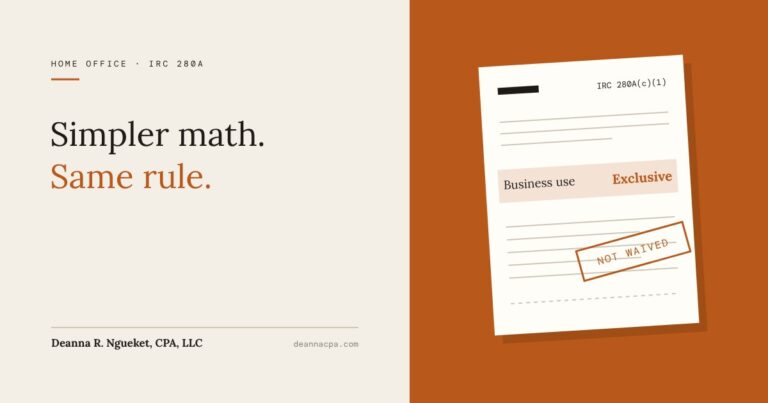
Most of the home office questions I get are about arithmetic. Should I measure the room or add up the bills? Is the simplified rate better than actual expenses?
Those are the second questions. The first one decides whether you get a deduction at all, and it comes down to a single word in the statute.
What the statute actually says
Section 280A of the Internal Revenue Code starts by shutting the door. Under IRC 280A(a), no deduction otherwise allowable “shall be allowed with respect to the use of a dwelling unit” that you use during the year as a residence. That is the default. Your home is personal, and personal expenses are not deductible.
Then IRC 280A(c)(1) opens the door partway. The general bar does not apply to an item allocable to a portion of the home “which is exclusively used on a regular basis” as the principal place of business for your trade or business, as a place where you meet patients, clients, or customers in the normal course of that business, or, for a separate unattached structure, in connection with that business.
Exclusively. Not mostly. Not primarily. Not usually.
IRS Publication 587 states the test in plain words: “To qualify under the exclusive use test, you must use a specific area of your home only for your trade or business.” Its own example is an attorney who writes legal briefs and prepares client returns in a den the family also uses for recreation. The publication’s conclusion is short: “The den is not used exclusively in your trade or business.” No deduction for the den. Not a reduced one. None.
The simplified method is a shortcut for the math, not for the gate
This is where I see owners go wrong, and I understand why. The simplified option sounds like the relaxed version. You take $5 per square foot of space used for business, up to 300 square feet, which caps the deduction at $1,500. No receipts to total, no allocation of the mortgage interest, no depreciation to track. It comes from Revenue Procedure 2013-13.
What it does not do is change who qualifies. The IRS says so on its own page for the simplified option: it “does not change the criteria for who may claim the deduction.” The same page lists the requirement under both methods identically. The space has to be used exclusively, on a regular basis, for business.
So the choice between the two methods is a choice about paperwork. It is not a choice about the standard you have to meet. If your space fails “exclusively,” the simplified method does not rescue it. It just gives you a faster way to calculate a deduction you are not entitled to.
The only two places the statute waives it
Congress did write exceptions, and there are exactly two.
Storage. Under IRC 280A(c)(2), space used on a regular basis to store inventory or product samples held for use in your trade or business of selling products at retail or wholesale escapes the exclusive use requirement, “but only if the dwelling unit is the sole fixed location of such trade or business.” So the owner who stores stock in a spare room and has no shop or warehouse elsewhere can use that space for other things too.
Daycare. Under IRC 280A(c)(4), space used regularly in a trade or business of providing day care for children, for individuals who have attained age 65, or for individuals physically or mentally incapable of caring for themselves is also excused. There is a condition attached in subparagraph (B): the owner or operator must have applied for the license, certification, registration, or approval required under state law and not been rejected, or hold one that has not been revoked, or be exempt from needing one.
That is the list. If your situation is not storage of inventory or licensed daycare, exclusive use applies to you.
The door most owners miss
Here is the part that changes outcomes, and it is sitting in the same subsection.
A lot of self-employed people assume they cannot claim a home office because the work itself happens somewhere else. The contractor is on job sites. The driver is on the road. The agent is at showings. The home is where the paperwork gets done, which feels like the lesser activity.
The statute says otherwise. The flush language in IRC 280A(c)(1) provides that “principal place of business” includes a place used for “the administrative or management activities” of the business “if there is no other fixed location of such trade or business where the taxpayer conducts substantial administrative or management activities of such trade or business.”
Read that carefully, because it is a real door. If your billing, scheduling, record keeping, and client calls happen at a desk at home, and there is no office, shop, or other fixed location where you do substantial amounts of that same work, that desk can be your principal place of business. The fact that the revenue is earned on a job site does not disqualify it.
The space still has to be used exclusively and regularly. The door is about what counts as your principal place of business, not about the word in front of it.
The ceiling, and what carries forward
One more limit worth knowing before you plan around a number. Under IRC 280A(c)(5), the deductions attributable to the business use cannot exceed the gross income derived from that use, reduced by your other deductions allocable to it. In plain terms, a home office deduction cannot create or deepen a loss.
The amount you lose to that ceiling is not gone. The statute provides that any amount disallowed for that reason “shall be taken into account as a deduction (allocable to such use)” for the succeeding taxable year. It carries forward. Publication 587 adds a practical wrinkle: the carryover is used in a later year in which you use the actual expense method.
If you are an employee, this is not your deduction
I want to be direct about this, because it comes up every January.
IRC 280A(c)(1) has a sentence aimed at employees: the exception applies to an employee “only if the exclusive use referred to in the preceding sentence is for the convenience of his employer.” But that is no longer the binding problem. The employee home office deduction was a miscellaneous itemized deduction, and IRC 67(h) disallows miscellaneous itemized deductions. The 2025 legislation struck the sunset date that had been written into that provision, so the disallowance is now permanent rather than scheduled to lapse.
If you work from home as a W-2 employee, there is no federal deduction to claim, under either method. This article is for the self-employed owner filing a Schedule C, and for owners whose businesses file their own returns.
What to do between now and December 31
If your home office space is doing double duty, you have time to fix it for this year rather than argue about it next spring:
- Pick a space you can genuinely keep to business only. A room is cleanest. A clearly defined portion of a room can work, but it has to be identifiable and it has to stay business-only.
- Move the personal items out. The guest bed, the exercise bike, the family computer.
- Measure the square footage and write the number down.
- Keep the records that establish the business use, and keep the bills if you may use actual expenses.
- If you do your admin at home and nowhere else, write down where your administrative work actually happens. That is the fact the administrative-or-management test turns on.
Ask me about these
Some situations need a conversation rather than an article, and these are the ones I would not want you to guess at:
- Whether a defined portion of a shared room holds up in your particular layout.
- How the home office interacts with depreciation and with gain when you sell the home.
- Whether to use the simplified rate or actual expenses when your actual costs are well above $1,500.
- How this works when the business is an S corporation rather than a Schedule C, which is a different analysis.
- Multiple businesses run from the same space.
Sources: IRC 280A(a), (c)(1), (c)(2), (c)(4), (c)(5); IRC 67(h); Rev. Proc. 2013-13; IRS Publication 587; IRS “Simplified option for home office deduction.”
Deanna R. Ngueket, CPA, LLC – serving Houston, Spring, Humble and Atascocita. Tax planning, tax preparation, and IRS notice resolution for individuals and business owners. deannacpa.com | info@deannacpa.com | 713-730-9792