A free guide from Deanna R. Ngueket, CPA, LLC
Every year around this time I tell business owners in Houston, Spring, Humble and Atascocita to collect their W-9s before the holidays. It is good advice, and it is only half of what I want you to know. The half that costs money is what happens when the W-9 does not come.
So this one is about the other side of it: not the paperwork, the arithmetic. There are two separate penalties for one missing form. The amounts that apply to your 2026 forms are not the ones published for this year. And there are four deadlines sitting between now and next August that decide the number — one of which may already have run, because the IRS mailed a batch of notices in October.
The collection side — how the solicitation rules work, and why a contractor you paid last year has no threshold at all this year — is a separate article, and I point you to it at the end of this one.
One form, two penalties
A 1099 is two documents that happen to look alike. One goes to the IRS. One goes to the contractor. The Code prices them separately.
IRC §6721 covers the return you file with the IRS, and it reaches two different failures: not filing by the required date, and filing a return that leaves out required information or has incorrect information on it. IRC §6722 covers the payee statement you furnish to the contractor, and it reaches the same two failures on that side.
Nothing in §6722 makes it an alternative to §6721. It is its own penalty with its own annual ceilings, and it borrows only its definition of a small filer from §6721. So a single contractor whose taxpayer identification number is wrong on both copies is not one penalty. It is two.
That is the detail I most often have to explain twice, because it is natural to assume one form means one penalty.
The amounts on your 2026 forms were set for 2027
These penalties are adjusted for inflation every year, and the adjustment does not key to the year you made the payment. It keys to the year the return was required to be filed.
Your 2026 1099s are required to be filed in early 2027. So the figures that apply to them come from Rev. Proc. 2025-32, which sets the amounts for returns required to be filed in 2027. They are:
| §6721 (the IRS copy) | §6722 (the contractor’s copy) | Both, per form | |
|---|---|---|---|
| Corrected within 30 days of the required filing date | $60 | $60 | $120 |
| Corrected after that, but on or before August 1, 2027 | $130 | $130 | $260 |
| Not corrected by August 1, 2027 | $340 | $340 | $680 |
| Intentional disregard | greater of $690 or 10% of the amount that should have been reported | same | no annual ceiling |
Dollar amounts from Rev. Proc. 2025-32 §§ 4.57 and 4.58; the correction dates from §§ 6721(b) and 6722(b) themselves.
Each of the two sections also has its own ceiling on what it can add up to in a single year, no matter how many forms went wrong — §6721’s ceiling and §6722’s are separate, so a business that trips both can face both. If your business averaged $5,000,000 or less in gross receipts over the three tax years ending before the calendar year in which the returns were required to be filed, §6721(d) makes you a small filer, and your ceilings are $1,397,000 in total, $244,500 if everything was fixed inside 30 days, and $698,500 if everything was fixed by August 1. A larger filer’s ceiling on the uncorrected tier is $4,191,500. All four figures come from Rev. Proc. 2025-32 § 4.57. For the businesses I work with, the ceiling is almost never the live issue. The per-form number is.
One figure in all of this is not indexed at all, and it is worth knowing because it goes in a letter you may end up writing. IRC §6723 charges the contractor $50 for failing to give you a TIN when you ask properly. Rev. Proc. 2025-32 does not adjust §6723 anywhere. That $50 has not moved.
Four clocks between now and next August
Here is the whole timeline for a 2026 form.
January 31, 2027 falls on a Sunday, so the Form 1099-NEC deadline — both furnishing it to the contractor and filing it with the IRS — moves to Monday, February 1, 2027.
Form 1099-MISC goes to the recipient by that same date, with one exception that matters later in this article: if you are reporting an amount in box 8 or box 10, the recipient statement is due February 15 instead. February 15, 2027 is Washington’s Birthday, so that one lands on Tuesday, February 16, 2027. Filing the 1099-MISC with the IRS is February 28 on paper — also a Sunday in 2027, so Monday, March 1 — or March 31, 2027 electronically.
Most small payers no longer have a paper option. The electronic filing threshold is 10 returns, and it is calculated by adding all your information returns together rather than counting each type on its own, under T.D. 9972 and the 2026 general instructions. Nine 1099s plus a handful of W-2s crosses it.
The cheapest tier ends about thirty days after the filing date. That is March 2, 2027 counting from January 31, or March 3 counting from the shifted February 1 date. Work to March 2 and the question never matters. Correct it in that window and you are at $120 a form — and do not spend the last day of it.
August 1, 2027 is the cliff, and I would treat it as hard. Correct it on or before August 1 and you are at $260 a form. Correct it after August 1 and you are at $680 — the same mistake, more than two and a half times the price, with nothing between the two but a date. End to end the spread is wider still: a form fixed inside the first thirty days costs $120, and the identical form left past August 1 costs $680, about 5.7 times as much. August 1, 2027 is itself a Sunday, and I would not plan a year around an extra day I might not get.
And there is a fourth clock that is already running for some people. That one is two sections down.
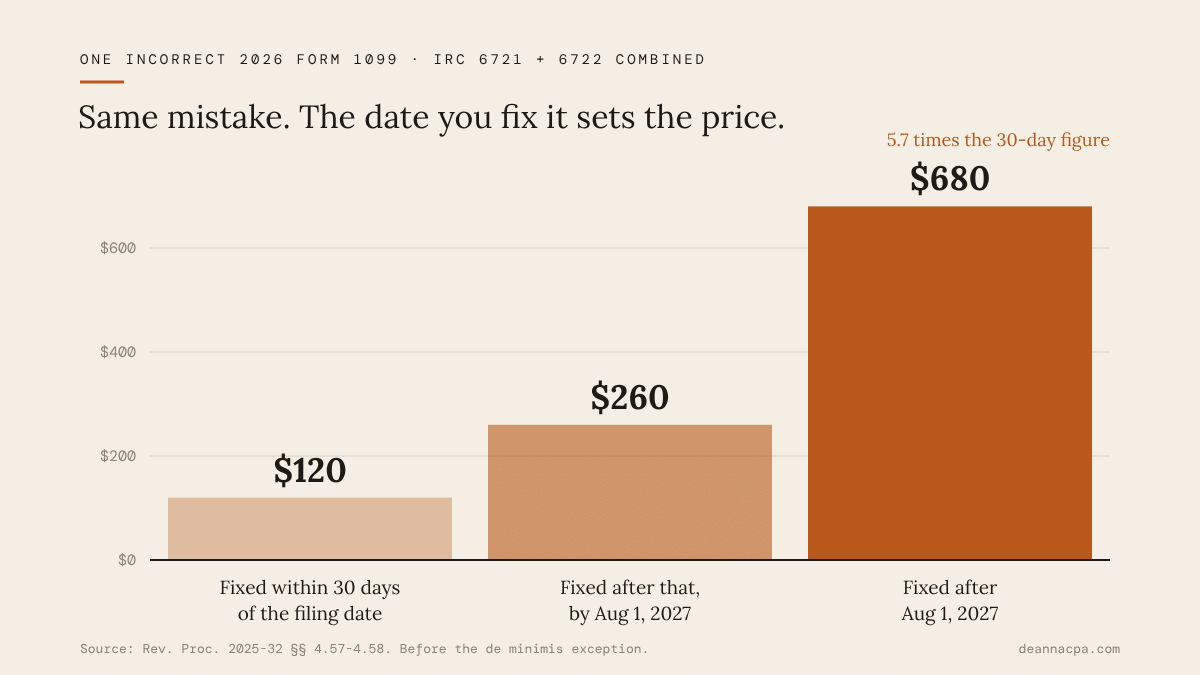
The combined §6721 and §6722 penalty for one 2026 form, by the date it is corrected. Amounts from Rev. Proc. 2025-32 §§ 4.57 and 4.58. This is the ladder before the de minimis rule in the next section, which can take a small number of filed returns off it entirely.
The de minimis rule that can take the whole thing to zero
§6721(c) is the provision I wish more owners knew about, because it rewards exactly the behavior I am asking for.
If a return was filed, and the problem is the kind described in §6721(a)(2)(B) — information left out or wrong, rather than a return you never sent at all — and you correct it on or before August 1 of the year the return was due, then the return is treated as having been filed with all of the correct required information. Not reduced. Treated as correct. §6722 carries its own version of the same rule at §6722(c), so both halves of the penalty can come off, but each has to be satisfied on its own terms.
There is a limit on how many returns this can cover in a year: the greater of 10, or one-half of one percent of the total number of information returns you were required to file that year. Note what the limit counts. It caps the number of returns the exception can cover, not the number you file. Two bad forms are under the floor of 10, so the percentage never comes into it and both can come off. Fourteen bad forms are over the floor: the exception reaches ten of them, and the other four stay on the ladder.
Read that together with the ladder above and the practical rule falls out on its own. File the forms on time even if a number or two is wrong, then fix them before August 1. Filing late is the one failure this rule does not reach.
If a CP2100 or CP2100A arrived in October, a clock is already running
The IRS mails CP2100 and CP2100A notices twice a year, in October and the following April. They tell you that names and TINs on information returns you filed are missing or do not match IRS records. Per the IRS’s own page on the notice, you get a CP2100 if 50 or more of your returns had errors, and a CP2100A if fewer than 50.
The deadlines attached to that notice are short, and they are counted in business days:
- 15 business days from the notice date, or from the date it reached you if that is later, to send the “B” notice to the payee. Publication 1281 is explicit that this one cannot be handled by telephone, and it tells you to mark the outside of the envelope “IMPORTANT TAX INFORMATION ENCLOSED.”
- 30 business days to begin backup withholding on a payee who has not come back to you. Publication 1281 counts those days from the date of the notice, and the IRS’s notice page counts from the day you received it, so work to the earlier of the two. You are allowed to start sooner.
- Backup withholding stops no later than 30 calendar days after you get what you asked for.
Put real dates on that. A notice dated Friday, October 16, 2026 put the B notice deadline at Friday, November 6, 2026 — already behind you. The thirty-business-day date is Friday, November 27 if Veterans Day and Thanksgiving count as business days and Tuesday, December 1 if they do not, so work to November 27. Either way it is days away, not months. If one of these came in and went into a pile, the pile is the problem — not the TIN.
The second B notice is the one that catches people
If the same payee TIN shows up on a CP2100 listing a second time within three calendar years, the second notice is a different animal, and this is where I see businesses do the right thing in the wrong way.
For a first B notice, a signed Form W-9 from the payee closes it.
For a second B notice, a W-9 does not, and Publication 1281 gives the signed Form W-9 as the cure for a first notice only. The second notice tells the payee the IRS is now required to disregard any future name and TIN combinations the payer furnishes. What closes it instead is validation from the source: an individual gives you a copy of a Social Security card showing the correct name and SSN, and a business validates its EIN with Letter 147C from the IRS. Both take time to obtain, which is exactly why a second notice has to go out on the same fifteen-business-day schedule as a first one, rather than after a phone call that goes nowhere.
The withholding is the bigger number
Everything above is the penalty on the form. The larger exposure is usually the withholding on the payment.
Backup withholding under §3406(a)(1) is set as the fourth lowest rate of tax under §1(c), which right now is 24% — the figure Publication 1281 states flatly. You deduct it, remit it on whichever deposit schedule you are on, and report it after year end on Form 945, Annual Return of Withheld Federal Income Tax.
What if you simply do not do it? §3406(h)(10) says that for withholding purposes, a payment subject to backup withholding is treated like wages. That matters because the wage rules are the ones that put unpaid tax on the business that should have withheld it, and §3403 says so in as many words. The IRS puts the consequence in ordinary language in the Instructions for the Requester of Form W-9: if you do not collect backup withholding from a payee who is subject to it, “you may become liable for any uncollected amount.”
That is 24% of the payment, out of your own money, against a penalty measured in hundreds of dollars. It is not close.
One mechanical point that surprises people: once you have withheld anything under the backup withholding rules, you must file a 1099 for that person regardless of the amount of the payment. The 2026 Instructions for Forms 1099-MISC and 1099-NEC say so in those words. The threshold has nothing to do with it.
The threshold did not move for everything
The reporting threshold for nonemployee compensation and for most Form 1099-MISC categories rose from $600 to $2,000 for payments made in 2026, under IRC §6041(a) as amended in 2025 and as stated in the 2026 Instructions for Forms 1099-MISC and 1099-NEC.
What did not change is the figure in box 10 of Form 1099-MISC, gross proceeds paid to an attorney. Those same December 2026 instructions still read: “Enter gross proceeds of $600 or more paid to an attorney in connection with legal services.” Treas. Reg. §1.6045-5, written under IRC §6045(f), sets that $600, and the instructions issued after the 2025 change still carry it.
The two kinds of payment to a law firm are reported differently, and that is the part that goes wrong:
- Fees you pay your own attorney for legal services are nonemployee compensation. Form 1099-NEC, box 1a, at the $2,000 threshold.
- Gross proceeds — a settlement check written to a law firm, including one where the firm keeps part of it and passes the rest to its client — go in box 10 of Form 1099-MISC, at $600. Treas. Reg. §1.6045-5(a)(1) applies this whether or not the legal services were performed for you, and §1.6045-5(e) confirms these payments are subject to backup withholding too.
If you settled anything in 2026 and a check went to a law firm, that is a box 10 form, the number that triggers it is $600, and the recipient copy is on the February 16, 2027 date rather than February 1.
Three examples
These are composites — illustrative fact patterns, not clients, and not anyone’s actual file.
A remodeling contractor in Humble
He paid nine subcontractors more than $2,000 each during 2026 and has W-9s for all nine. When the forms go out, two of the TINs come back as mismatches.
He files all nine on February 1, 2027 and corrects the two in late February. The forms went in on time, the fix came months before August 1, and two bad forms is inside the greater-of-10 limit. So on the §6721 side those two returns are treated as correct — not cheaper, correct — and §6722(c) can do the same on the contractor’s-copy side.
Two things to notice. The exception does not depend on his moving fast in February; it runs to August 1, so a correction in May would have done the same job. What it does depend on is filing in the first place and staying inside the limit. Let those two forms run past August 1, 2027 and the exception goes with the date: two forms at $340 under §6721 and $340 under §6722 is $1,360.
Now add a tenth sub. This one never sent a W-9, and he paid him $47,000 across the year without withholding anything. The two penalties on that one unfiled form run to $680. The 24% he was required to withhold is $11,280 — about 16.6 times the penalty. The form was never the expensive part.
A for-hire carrier in Atascocita
A small carrier settles with around twenty owner-operators on 1099s. A CP2100A arrived in October listing 14 error documents — fewer than 50, which is why it was the “A” version.
Start with what that notice is and is not. Those errors are on the forms he filed in early 2026 — his 2025 forms. Those carry the amounts set for returns required to be filed in 2026, and their August 1 correction date went by this past summer. So the notice is not a chance to fix that year. It is a warning about the forms he is about to file in February, plus a set of B notice and withholding deadlines that are live right now.
Eleven drivers send back what was asked for. Three do not. Those three are due roughly $9,000 each, and from the thirty-business-day date he has to withhold 24% on every settlement to them going forward. If each of the three has one more $9,000 settlement after that date, the 24% on $27,000 is $6,480 to deduct, deposit and report on Form 945 — and each of those three nets $6,840 instead of $9,000 until the paperwork lands. That is a conversation worth having with a driver in advance, not on a Friday.
Two things make the February filing worse than it looks. First, two of those three names were on the April 2026 listing as well, so for those two a W-9 will not close it; he needs a Social Security card copy or a Letter 147C, and those take weeks to obtain. Second, if those fourteen names are still wrong on the forms he files in February 2027, this is the rare case where the de minimis limit bites. His cap is the greater of 10 or half a percent of what he files, which at his size is 10. The exception would reach ten of the fourteen. The other four stay on the ladder no matter how quickly he fixes them.
A north Houston company that settled a dispute
The business settled a contract claim in 2026. A settlement check went to the other side’s law firm, and it paid about $12,000 in fees to its own attorney.
The $12,000 is nonemployee compensation: Form 1099-NEC, box 1a, $2,000 threshold. The settlement check is gross proceeds: Form 1099-MISC, box 10, and the threshold there is $600.
Say the settlement check was $85,000 and the box 10 form is simply missed, then corrected after August 1, 2027. That is $680 under §6721 and §6722 combined. But if the IRS concludes the omission was intentional disregard of the filing requirement, §6721(e)(2)(A) and §6722(e) each charge the greater of $690 or 10% of the amount that should have been reported — on $85,000 that is $8,500 on each side, $17,000 together — and the annual ceilings do not apply to it. (There is a 5% rate in the statute rather than 10%, but §6721(e)(2)(B) gives it only to broker returns under §6045(a) and two other sections. An attorney-payment return under §6045(f) is not among them.)
Twenty-five times the ordinary figure. What moves it there is not the size of the payment. It is what the record shows about whether you knew.
If Notice 972CG has already arrived
Notice 972CG is a Notice of Proposed Civil Penalty. It is how the IRS proposes a §6721 penalty, both for returns filed late and for returns that came in with missing or incorrect TINs.
The Internal Revenue Manual gives you 45 days to respond, or 60 if you are overseas (IRM 4.19.25.2), and that response is where you make the case that the penalty should not apply. If you need more time, ask for it in writing before the period ends, not after. A notice dated October 16, 2026 is answerable through November 30, 2026.
This is not a bill you sort out later. The response window is the opportunity.
Why first-time relief does not reach these
This is the assumption I correct most often. The IRS’s Automatic Exemption from Penalty, announced in IR-2026-83, is taking over from first-time abatement for returns with original due dates on or after January 1, 2027.
The penalties the IRS lists as eligible for either program are failure to file, failure to pay and failure to deposit, and the forms it lists are income and employment tax returns — the 1040, 1065, 1120, 940 and 941 family. The 1099 series is not on either list. On the face of what the IRS has published, neither program reaches a §6721 or §6722 assessment, and I would not count on a clean compliance history to get you out of one.
What is available is reasonable cause under IRC §6724(a) and Treas. Reg. §301.6724-1. That regulation does not ask whether you have a W-9 in the file. It asks whether you acted in a responsible manner — whether you made the solicitations the regulation specifies, on the regulation’s schedule, and whether you can show it. Mitigating factors or events beyond your control are not enough on their own; under §301.6724-1(a)(2) the responsible-manner showing is required either way.
I covered that solicitation schedule, including the December 31 annual deadline and why a contractor you paid last year has no threshold this year, in the prior-year contractor and backup withholding article. If you have a missing TIN on your hands, that is the piece to read next.
What I would do between now and February 1
- Go through your mail for an October CP2100 or CP2100A. The fifteen- and thirty-business-day clocks run from the notice date, or from the day it actually reached you if that is later — not from the day you finally opened the envelope. If it has been sitting in a pile, both of those dates are behind you or nearly so.
- Pull a payee list now, not in January. Every vendor paid $2,000 or more, every attorney paid $600 or more in gross proceeds, and anyone from whom you have withheld anything, regardless of amount.
- Decide who is getting backup withholding in December rather than discovering it in February, and tell those people before their next payment.
- File on time even if a number is wrong. The de minimis rule reaches an incorrect return you filed. It does not reach a return you did not file.
- Put August 1, 2027 on the calendar now. It is the date the price changes, and it is the one deadline here with no form, no notice and no filing attached to it — so nothing is going to surface it for you.
Ready to get your 1099 filings and your W-9 file in order before the February deadline, or to deal with a notice that has already arrived? Call (713) 730-9792 or get in touch. You can also read more about how our IRS notice resolution service works.
General information current as of November 2026, not advice for your situation. Whether any provision described here applies to you, and what it produces if it does, depends on facts this article cannot know. Deanna R. Ngueket, CPA, LLC – certified public accountant licensed in the State of Texas.