Every October a client asks me some version of the same question. He is looking at a new truck, somebody told him that if it weighs more than 6,000 pounds he can write the whole thing off, and he wants to know if that is true.
It is half true, which is the worst kind. Clearing 6,000 pounds does something real. It just does not do the thing he thinks it does.
Two different limits, stacked
There are two separate ceilings sitting on a business vehicle, and the weight test only removes the first one.
The first ceiling is IRC 280F. It caps annual depreciation on what the statute calls a “passenger automobile.” Under IRC 280F(d)(5)(A), a passenger automobile is a four-wheeled vehicle “rated at 6,000 pounds unloaded gross vehicle weight or less” — and for trucks and vans, the statute substitutes gross vehicle weight for unloaded gross vehicle weight. So the familiar 6,000-pound number is not a Section 179 rule at all. It lives in 280F, and it is a definition, not a benefit.
For a vehicle that is inside that definition, Revenue Procedure 2026-15 sets the 2026 ceilings: $20,300 in year one if bonus depreciation applies, $19,800 in year two, $11,900 in year three, and $7,160 for every year after that. That is the cap my client is trying to escape, and above 6,000 pounds he does escape it.
The second ceiling is IRC 179(b)(5), and almost nobody mentions it. It caps the Section 179 deduction on a sport utility vehicle. For 2026 that cap is $32,000, under section 4.24 of Revenue Procedure 2025-32.
Look at how the two fit together. IRC 179(b)(5)(B)(i) defines a sport utility vehicle, for this purpose, as a four-wheeled vehicle that carries passengers on public roads, is “not subject to section 280F,” and is “rated at not more than 14,000 pounds gross vehicle weight.”
Read that middle condition again. Not subject to section 280F. Clearing 6,000 pounds is exactly what makes a vehicle not subject to 280F. So the thing that gets you out of the first ceiling is the same thing that puts you under the second one.
That is the trap. The weight sticker is a door between two rooms, not a door to the outside.
The three exits
IRC 179(b)(5)(B)(ii) is where it gets useful. It lists three kinds of vehicle that are not sport utility vehicles for this purpose at all — and a vehicle that falls outside the definition is not subject to the $32,000 cap, because the cap only applies to sport utility vehicles.
The three exits, in the statute’s own terms:
One: seating. A vehicle “designed to have a seating capacity of more than 9 persons behind the driver’s seat.” This is a shuttle van, not a pickup.
Two: the cargo area. A vehicle “equipped with a cargo area of at least 6 feet in interior length.” The statute then describes what that area has to be: an open area, or designed for use as an open area “but is enclosed by a cap and is not readily accessible directly from the passenger compartment.”
Three: the integral enclosure. A vehicle with “an integral enclosure, fully enclosing the driver compartment and load carrying device,” which has no seating rearward of the driver’s seat and no body section protruding more than 30 inches ahead of the leading edge of the windshield. That is a cargo van or a box truck.
Exit two is the one that matters to most of the people I work with.
What that means in a driveway in Humble
A crew-cab pickup rated above 6,000 pounds is out of the 280F caps. Whether it is also out of the $32,000 Section 179 cap depends on the bed.
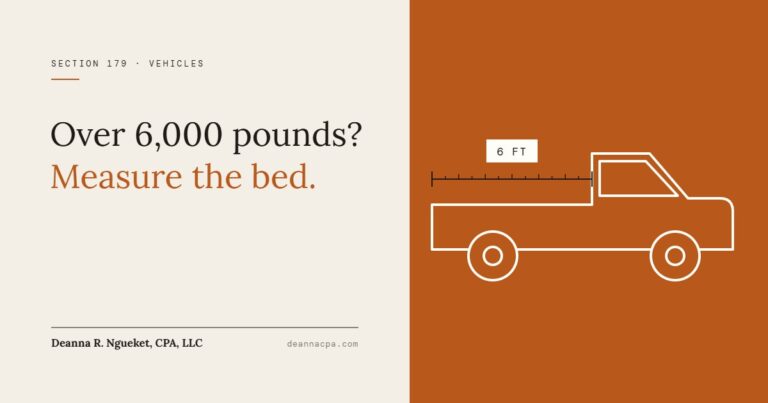
Measure the interior length of the cargo area. Six feet or more, open, and the vehicle is not a sport utility vehicle under 179(b)(5)(B)(ii)(II). The $32,000 cap does not reach it.
A short-bed crew cab — five and a half feet is a common configuration — does not clear that test. Same truck, same weight, same price, same work. Different number on the return.
And notice the qualifier, because it decides real cases: if the bed is covered, the cap has to leave it “not readily accessible directly from the passenger compartment.” A shell or tonneau over an otherwise open bed is one thing. A configuration that opens into the cabin is a different thing, and the statute cares about the difference.
This is not a loophole. It is a definition, written into the statute, and the measurement is sitting in the driveway.
Three things that still apply either way
Clearing the SUV cap is not the end of the analysis.
You need more than 50 percent business use. IRC 280F(b)(3) treats listed property as predominantly used in a qualified business use only if the business use percentage for the year exceeds 50 percent. A passenger automobile is listed property under 280F(d)(4)(A)(i).
It can be clawed back. Under IRC 280F(b)(2), if the vehicle qualified in the year you placed it in service and then fails the test in a later year, the excess depreciation comes back into gross income in that later year, and depreciation from then on moves to the alternative depreciation system under 168(g). A truck that was 80 percent business in 2026 and becomes the vehicle your son drives to college in 2028 is not a settled deduction. It is an open one.
Section 179 cannot create a loss. IRC 179(b)(3)(A) limits the deduction to your aggregate taxable income from the active conduct of a trade or business. If the business nets $30,000, a $70,000 Section 179 election does not produce a $40,000 loss — the excess carries forward under 179(b)(3)(B). Bonus depreciation under 168(k) has no equivalent limit, which is one of the real reasons to choose between them rather than assuming they are interchangeable. Bonus is 100 percent and permanent for property acquired after January 19, 2025, so for most vehicle purchases there is a genuine choice to make.
And the deduction follows the date the vehicle is placed in service — ready and available for use — not the date you sign the paperwork.
What I would do before you buy
Three things, and the first one takes thirty seconds:
- Find the gross vehicle weight rating. It is on the sticker in the driver’s door jamb.
- Measure the interior length of the cargo area, and know whether it is open or capped, and if capped, whether it opens into the cabin.
- Write down, honestly, what share of the miles will be business miles — and what that share will look like in three years, not just this one.
Bring me those three answers and I can tell you what the vehicle is actually worth to you on the return, before you sign anything. That conversation is a great deal cheaper before the purchase than after it.
Sources
- IRC 179, including the (b)(3) taxable income limitation and the (b)(5) sport utility vehicle rules: www.law.cornell.edu/uscode/text/26/179
- IRC 280F, including the (d)(5) passenger automobile definition and the (b) business-use and recapture rules: www.law.cornell.edu/uscode/text/26/280F
- Revenue Procedure 2025-32, section 4.24, for the 2026 Section 179 dollar limits: www.irs.gov/pub/irs-drop/rp-25-32.pdf
- Revenue Procedure 2026-15, for the 2026 passenger automobile depreciation limits: www.irs.gov/pub/irs-drop/rp-26-15.pdf
- IRS guidance on the 100 percent additional first year depreciation deduction, Notice 2026-11: www.irs.gov/newsroom/treasury-irs-issue-guidance-on-the-additional-first-year-depreciation-deduction-amended-as-part-of-the-one-big-beautiful-bill
Dollar limits in this article are the 2026 figures and they move with inflation each year. The IRS posts the current ones in its annual revenue procedures at the links above.
I am Deanna R. Ngueket, CPA, and I work with contractors, owner-operators, and self-employed professionals in Houston, Spring, Humble and Atascocita on tax planning, tax preparation, and resolving IRS and state notices. If you are looking at a vehicle before year end, reach me at info@deannacpa.com or 713-730-9792.
This article is general information, not advice for your situation. Deanna R. Ngueket, CPA, LLC.