A free guide from Deanna R. Ngueket, CPA, LLC
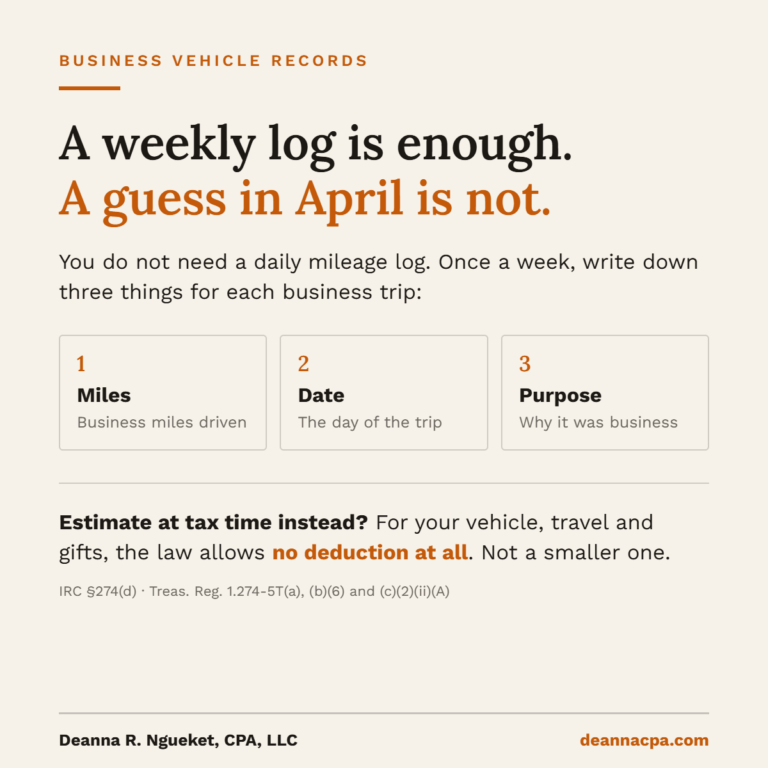
The recordkeeping standard most business owners carry in their head is stricter than the one written in the regulation. You do not need a daily log.
What the regulation actually says
Treas. Reg. 1.274-5T(c)(2)(ii)(A) says a record has to be made “at or near the time” of the expense, and it defines that as a moment when you have “full present knowledge” of the amount, time, place and business purpose.
Then it says this, in its own words: “a log maintained on a weekly basis, which accounts for use during the week, shall be considered a record made at or near the time of such use.”
Weekly. Sitting down on Friday with your calendar and your card statement is not a workaround. It is the standard, met.
The other half: no estimate at all
That is the generous half. Here is the other one, and it is why the first half matters.
For most of your return, a deduction with imperfect records still gets you somewhere. A court can estimate. Three categories are carved out of that by statute: travel, gifts, and your vehicle, which is in there as listed property under IRC section 280F(d)(4).
IRC section 274(d) allows no deduction for those unless you substantiate the amount, the time and place, the business purpose, and your business relationship to anyone who received it. And the regulation at 1.274-5T(a) is blunt about the consequence. Section 274(d) “contemplates that no deduction or credit shall be allowed a taxpayer on the basis of such approximations or unsupported testimony of the taxpayer.”
Not a reduced deduction. No deduction.
So the gap between Friday and April is not a matter of tidiness. It is the difference between a deduction you keep and one that is gone.
How narrow the exception is
How narrow the relief is tells you the rest. Under 1.274-5T(c)(5), records lost to fire, flood, earthquake or other casualty may be substantiated by reasonable reconstruction. A casualty. Not a busy quarter.
What the weekly entry has to hold
For a vehicle: business mileage, the date, and the business purpose. That is Treas. Reg. 1.274-5T(b)(6). Three items.
Receipts sit on top of that, and only in two places: lodging while you are away from home, and any other expense of $75 or more. Treas. Reg. 1.274-5(c)(2)(iii).
The penalty that follows thin records
One more thing worth knowing. Treas. Reg. 1.6662-3(b)(1) defines negligence to include “any failure by the taxpayer to keep adequate books and records or to substantiate items properly.” That is the opening for the 20 percent accuracy-related penalty under IRC section 6662, on top of the tax you now owe.
Three items, once a week, on the same day you already look at your numbers.
If you would like me to look at how you are tracking travel, gifts and vehicle use before year end, you can reach me through my contact page or at info@deannacpa.com.
Primary sources: IRC §274(d); IRC §280F(d)(4); IRC §6662; Treas. Reg. §1.274-5T; Treas. Reg. §1.274-5(c)(2)(iii); Treas. Reg. §1.6662-3(b)(1).
General information current as of September 2026, not advice for your situation. Whether any provision described here applies to you, and what it produces if it does, depends on facts this article cannot know. Deanna R. Ngueket, CPA, LLC – certified public accountant licensed in the State of Texas.
Self-employed? See my guide to quarterly taxes for 1099 contractors.