The threshold that changed is not about your income
For payments made in 2026, a business only has to file a Form 1099-NEC or 1099-MISC for you once it has paid you $2,000 or more for the year. That figure is in Internal Revenue Code section 6041(a), and section 6041(h) indexes it for inflation after 2026. It used to be $600.
Most of what has been written about that change is written for the business doing the paying. This post is written for you, the person getting paid.
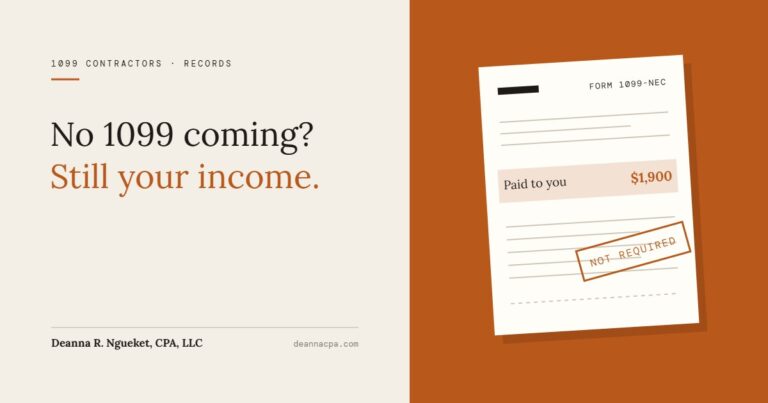
Here is the part that matters for you: section 6041(a) is a rule about when your client has to file a form. It is not a rule about what counts as your income. Your income is gross income under section 61(a) whether a form arrives or not. If three clients each paid you $1,800 this year, none of them owes you a 1099, and all $5,400 is still reportable.
So the practical effect of a higher threshold is not that you owe less. It is that fewer pieces of paper will show up in January to remind you what you earned.
The duty to keep records is yours, and it is written separately
People often assume their records are a backup for the 1099s. The regulation says the opposite. Treasury Regulation 1.6001-1(a) requires any person subject to income tax to
keep such permanent books of account or records, including inventories, as are sufficient to establish the amount of gross income, deductions, credits, or other matters required to be shown by such person in any return of such tax or information.
Read that standard again: sufficient to establish the amount of gross income. Not sufficient to match the forms you received. The authority behind it is Code section 6001, which requires every person liable for tax to keep records.
That duty has always been yours. What changed in 2026 is that for your smaller clients, your records are now the only record there is.
The year-end checklist
1. List every client who paid you under $2,000. These are the ones no form is coming from. Go through your bank deposits and your invoices and write the names down now, while you still remember who they were. In February you will not.
2. Close the year on the right side of December 31. You are almost certainly on the cash method, and Treasury Regulation 1.446-1(c)(1)(i) says all items of gross income “are to be included for the taxable year in which actually or constructively received.” A client’s check in your hands on December 30 is 2026 income even if you deposit it on January 5. Regulation 1.451-2(a) adds constructive receipt: income counts when it is “credited to his account, set apart for him, or otherwise made available so that he may draw upon it at any time.”
3. Check your payment platforms. Form 1099-K is back to the old threshold for 2026: a platform only has to report you if your gross payments exceed $20,000 and the number of transactions exceeds 200, per the Instructions for Form 1099-K (Rev. December 2026) and Code section 6050W. Miss either leg and you get nothing. Plenty of real businesses run well under 200 transactions a year.
4. Reconcile the forms that do arrive. Do not just adopt them. If a 1099-NEC says you were paid more than you were, your records are what you report, and you ask that payer for a corrected form. The form is their statement about you. It is not the final word on your income.
5. Know the number that decides whether you file at all. Section 6017 requires a self-employment tax return from every individual with net earnings from self-employment of $400 or more. Four hundred dollars, not four thousand.
6. Keep the records longer than you think. Regulation 1.6001-1(e) says records must be retained “so long as the contents thereof may become material in the administration of any internal revenue law.” Section 6501 tells you when that is. Three years after filing is the normal assessment period under 6501(a). It becomes six years if you leave off more than 25% of the gross income shown on the return, under 6501(e)(1)(A). And there is no limit at all if you never filed a return, under 6501(c)(3), or if the return was fraudulent, under 6501(c)(1). “Keep it three years” is the floor, not the rule.
Two dates
Your fourth-quarter 2026 estimated tax installment is due January 15, 2027.
Payers have to furnish your 2026 1099s by January 31, 2027 — but that is a Sunday, so the date shifts to the next business day, Monday, February 1, 2027. If you are still waiting on a form in mid-February, that is late, and your own records are what you file from in the meantime.
Things I would want to look at with you, not guess at
A few of these turn on your specific facts, and I would rather you ask me than read a general answer into your own situation:
- Whether a particular platform payment is reported under section 6050W or under 6041 or 6041A. The de minimis threshold is disregarded in deciding which section applies, which is not intuitive.
- What to do when a corrected 1099 shows up after you have already filed.
- Whether you are actually on the cash method. Most self-employed people are, but not all, and it changes answer number 2 completely.
Sources
IRC 61(a); IRC 6001; IRC 6017; IRC 6041(a) and (h); IRC 6050W; IRC 6501(a), (c)(1), (c)(3) and (e)(1)(A); Treas. Reg. 1.6001-1(a) and (e); Treas. Reg. 1.446-1(c)(1)(i); Treas. Reg. 1.451-2(a); Instructions for Form 1099-K (Rev. December 2026); IRS, “How long should I keep records?”
If you are self-employed in Houston, Spring, Humble, or Atascocita and you would like someone to go through this with you before the year closes, I am at info@deannacpa.com or 713-730-9792.
— Deanna R. Ngueket, CPA